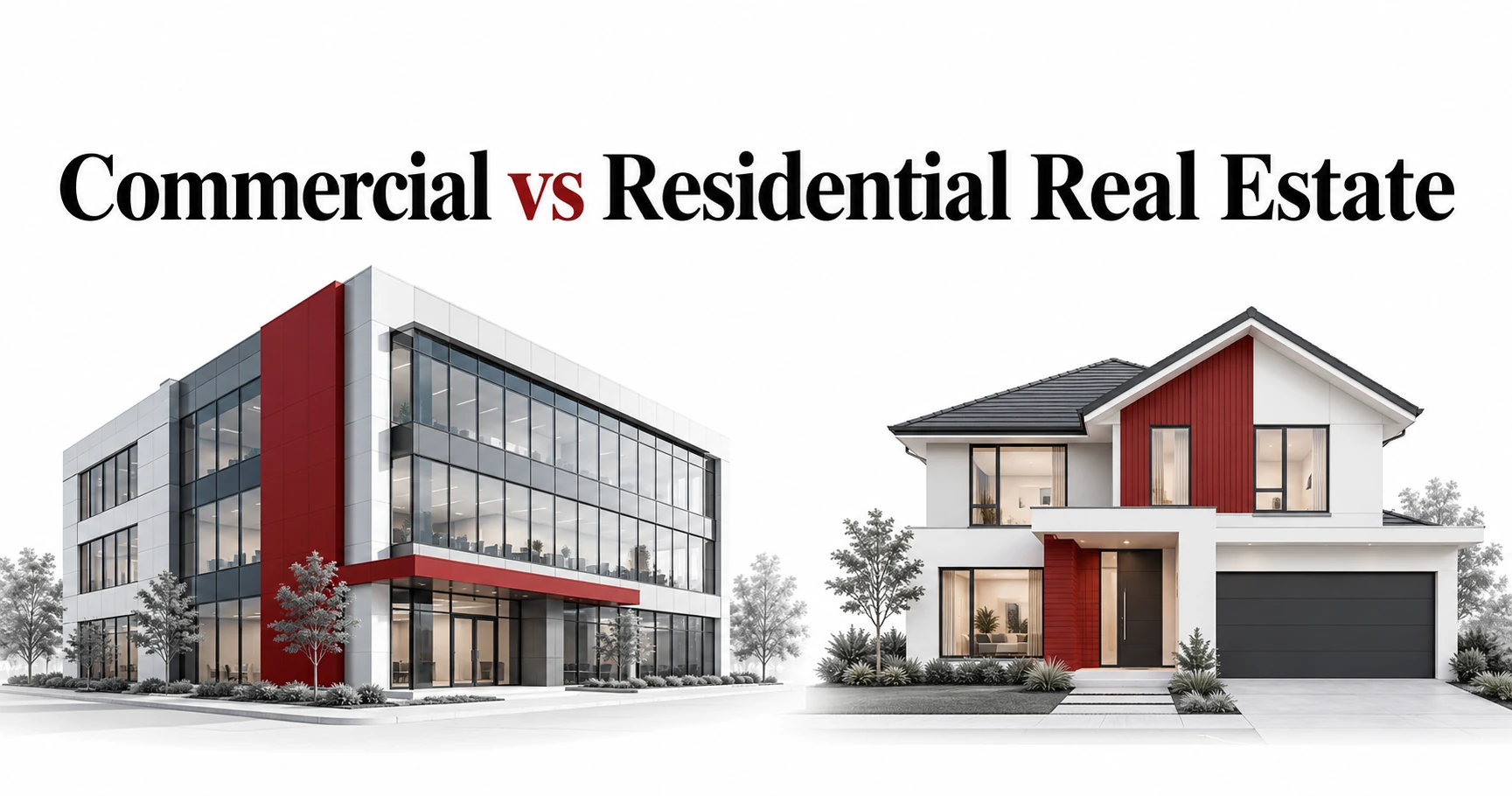
Most investors don’t struggle because they picked a bad looking property. They struggle because the property didn’t match their finances, experience, or risk tolerance. That’s why the commercial vs residential real estate decision matters so much.
Both property types can generate income and long-term value, but they work very differently. Financing, leases, tenant risk, and even how a property is valued all change. To see how we approach decisions like these, start with AIMS Across.
This guide compares 12 key differences using current U.S. market data and practical examples. Figures are U.S. based unless stated otherwise, and lending, tax, and zoning rules vary by location.
What’s the Difference Between Residential or Commercial Property?
The difference between residential and commercial property comes down to who uses the building. People live in residential property. Businesses operate in commercial property.
Residential covers the single family home, the duplex, and the fourplex. Commercial includes office buildings, retail spaces, industrial properties, warehouses, hotels, and mixed-use properties.
How lenders see it: In the US, one to four units usually count as residential. An apartment building with five or more units counts as commercial. Other countries draw the line elsewhere. Zoning decides what a building can legally do.
The label decides your loan. Confirm it before you fall in love with the building.
The 12 Differences Between Commercial and Residential Real Estate
Run through these before you sign anything. Each one takes minutes to check. Together they filter out most bad deals.
1. Who Rents the Property
Residential tenants are individuals and families. They rent to live. Commercial tenants are businesses. They rent to earn.
That changes behavior. A family leaves when life changes. A business leaves when sales drop. Ask what could push your tenant out.
2. How Long the Lease Runs
Residential leases commonly run for shorter periods, often around one year. Commercial lease terms can extend several years. Longer leases may provide more predictable income.
However, a long lease is not automatically a good lease. Rent increases, renewal options, maintenance obligations, guarantees, and termination clauses all affect its value.
A poorly negotiated five year agreement can create problems for much longer than a twelve month residential lease. Lease quality matters as much as lease length.
3. Who Pays the Operating Costs
The overlooked issue in many commercial deals is not the advertised rent. It is the lease structure.
A triple net lease may require a tenant to pay certain property taxes, insurance, and maintenance expenses. A gross lease places more operating costs on the landlord. Other commercial agreements divide expenses differently.
Residential landlords commonly remain responsible for many major property costs, although local law and lease terms matter.
Commercial properties may also involve common area maintenance charges, often called CAM charges. Never compare two properties using rent alone. Compare the income left after the expenses you actually have to pay.
4. How the Property Is Valued
Residential properties are usually valued using comparable sales, where an appraiser looks at similar nearby homes and adjusts for differences.
Commercial properties depend more on the income they earn, and common methods include income capitalization, comparable sales, replacement cost, and discounted cash flow analysis.
A key measure is net operating income (NOI), which is the property’s income minus operating expenses, before loan payments.
For example, a property with $70,000 of NOI at a 7% cap rate is worth $1,000,000 ($70,000 ÷ 0.07). If NOI rises by $7,000 and the cap rate stays at 7%, the value rises by about $100,000.
This means commercial investors can add value by raising income or cutting costs. Residential investors can also add value through renovations and better management, but home values are usually less directly tied to NOI.
- Rental Yield and Cap Rate
Returns are a major reason investors look at commercial property vs residential property. However, percentages need context. The Global Property Guide reported an average gross for U.S. cities in its Q2 2026 dataset.
Results varied a lot by city and property type. ATTOM’s 2026 showed that rental yields dropped in 54.8% of the 341 counties analyzed from 2025.
A higher cap rate doesn’t always mean a better deal. It might mean weaker tenants, slower growth, tough locations, higher vacancy risk, or more uncertainty.
Consider a simple example. A $300,000 rental home generates $15,000 in annual NOI, with a cap rate of 5%. A $1 million retail property generates $70,000 in annual NOI and has a 7% cap rate.
But that doesn’t mean the retail property is better. Also think about financing, vacancy rates, lease terms, capital costs, and tenant quality.
6. Down Payment and Loan Type
Residential and commercial financing differ. Residential investment properties often use standard mortgage products. Lenders usually look at:
- Borrower income
- Credit history
- Debt obligations
- Loan-to-value ratio
- Property type
Commercial financing relies more on a property’s income and performance. Commercial loans often need a bigger equity contribution than residential loans do.
There’s no set down payment percentage. It changes based on the lender, borrower, property, occupancy, and loan type. Investors should compare real loan quotes. Don’t rely on a generic percentage.
7. How Lenders Test the Deal
Commercial lenders commonly evaluate the property’s ability to support its debt. One important measurement is the debt service coverage ratio, or DSCR.
The basic formula is: DSCR = NOI ÷ Annual Debt Service.
Suppose a property produces $70,000 in NOI.
Annual loan payments equal $50,000. The DSCR would be: $70,000 ÷ $50,000 = 1.40
A ratio above 1.0 means the property’s NOI exceeds its scheduled debt payments. The minimum acceptable ratio varies by lender and property type. Loan to value ratio also matters.
Residential underwriting often places greater emphasis on the borrower’s personal financial profile.
Commercial underwriting examines both the borrower and the property’s economics.
8. Balloon Payments and Refinance Risk
Some commercial loans are paid off slowly, as if they will last many years. But the loan actually ends much earlier. The owner must then pay the rest at once. This is called a balloon payment.
To do this, the owner may need a new loan (refinancing) or must pay in cash. This can go wrong when:
- Interest rates go up
- The property loses value or earns less income
- More units are empty
- Banks become stricter
That is why stress testing matters. Ask “what if” questions: higher interest, lower rent, more empty units, surprise repair costs. Then check if the property still works.
Refinance risk can turn a good investment into a cash flow problem.
9. Workload and Tenant Calls
Residential ownership often creates frequent but smaller management issues. Commercial ownership may produce fewer calls, but each problem can become more complex. Consider two illustrative conversations.
Residential:
Tenant: “The heater stopped working.”
Owner: “I’ll arrange a technician.”
Commercial:
Tenant: “We need approval to install a walk-in freezer.”
Owner: “Send the plans first. We need to check the lease, permits, and building requirements.”
Commercial properties can also require tenant improvements before a new business moves in. Residential and commercial investing both require management. The type of management simply changes.
Owning the property is only half the job. To understand who protects your interests, explore our guide: What Is a Property Manager’s First Responsibility to the Owner?
10. Vacancy and Market Risk
Risk in residential vs commercial real estate depends on the sector and the cycle.
The U.S. office market provides a useful example. Yardi Matrix reported ,which was 1.7 points lower than a year earlier. But this national number does not fit every city. San Francisco, Seattle, Austin, Manhattan, and smaller cities can look very different.
Cotality reported. That is still below the usual growth level. National averages are only where research starts.
Also check local empty units, new buildings being built, population growth, tenant demand and jobs, rents on similar properties, how long properties take to sell, and when leases end.
Commercial is not always high risk, and residential is not always safe in a downturn. The real risk depends on the property type, the tenants, the loan, and the location.
11. Liquidity: How Fast You Can Sell
Fewer people want to buy a shopping centre than a three bedroom home. Selling a commercial property can take many months. A home is easier to sell, because both families and investors want to buy it.
Liquidity means how fast you can turn a property into cash. This matters when your life changes and you need money quickly. So plan how you will sell before you buy.
12. Tax Treatment
Tax rules are different in every country. In the US, a residential rental building is written off over 27.5 years. A commercial building is written off over 39 years. This write off is called depreciation, and it lowers the income you pay tax on.
Costs to run the property and property taxes can usually be deducted too. When you sell, you may pay capital gains tax on your profit. A 1031 exchange can delay this tax. This is not tax advice.
Twelve differences, one theme: Residential is simpler but usually earns less. Commercials are more complex but can earn more.
Commercial vs Residential Real Estate Pros and Cons at a Glance
We built this table for commercial property vs residential property: we compared common lender rules, lease patterns, and the 2026 reports cited above. Individual deals vary.
| Factor | Residential | Commercial |
|---|---|---|
| Initial capital | Often lower | Often higher |
| Tenant pool | Usually broader | More property and business specific |
| Lease length | Commonly shorter | Often longer |
| Expense structure | Landlord often carries more costs | Costs may be shared or passed through |
| Income potential | Depends heavily on local rents and costs | Can offer stronger income potential |
| Vacancy | Often easier to refill in active housing markets | Can take longer for specialized space |
| Financing | More standardized options available | More property-specific underwriting |
| Valuation | Heavily influenced by comparable sales | Greater emphasis on property income |
| Liquidity | Often broader buyer pool | Buyer pool can be narrower |
Neither column wins every category. That is exactly why the decision needs to start with the investor’s goals.
What Are the Benefits of Investing in Commercial Real Estate vs. Residential Real Estate?
Both have their own benefits. The right choice depends on your money, your time, and your goals.
Commercial Real Estate
- Higher income: Rent is often higher compared to the price.
- Longer leases: Tenants stay for many years, so income is more steady.
- Tenants pay some costs: Many leases make tenants pay for repairs, taxes, and insurance.
- Value can grow: If the income goes up, the property value can go up too.
Residential Real Estate
- Easier to start: Loans are simpler and the down payment is often smaller.
- Easier to sell: Many people want to buy homes.
- Steady demand: People always need a place to live.
- Easier to understand: Most people already know how homes work.
Commercial can earn more but are harder and cost more. Residential is simpler but usually earns less.
Commercial vs Residential Real Estate for Beginners: Where Should You Start?
Start with residential. Here’s the blunt truth. Skip commercials as your first deal unless you have deep cash reserves and a mentor.
- Start with a residential investment. You learn tenant screening, repairs, and cash flow math while mistakes stay small. A mistake on a $300,000 house hurts. A mistake on a $3 million building can end your plans.
- Try house hacking. Buy a duplex and live in one unit. Your tenant helps pay your mortgage. Our house hacking guide shows how.
- Scale to a fourplex. You get commercial style income with home style loans.
- Try a commercial investment without a building. A REIT lets you buy shares in a company that owns income properties. You can sell fast, and you get diversification. A syndication pools investor money under a sponsor. Your cash can stay locked for years, so vet the sponsor’s track record and fees.
Which Real Estate Investment Is Better, Commercial or Residential? Five Questions to Ask
Should I invest in commercial or residential real estate? Copy this list. Answer each one honestly.
- How much cash can you lose without losing sleep? Smaller reserves point to residential. Larger reserves open commercially.
- How many hours can you give each week? Hands on time suits residents. Contract heavy work suits commercial.
- How steady must your income be? Long leases help commercials. A deep tenant pool helps residential.
- What is your goal? Monthly income favours higher cap rates. Long term growth favours well located homes or rising NOI.
- What does your local market pay? Compare local cap rates, rents, and vacancy before you decide.
Three quick scenarios:
- You have a steady job and modest savings. Choose residential or small multifamily.
- You own rentals and hold real reserves. Consider small commercials with triple net leases.
- You want income without the calls. Consider a REIT or syndication.
Still not sure which scenario sounds like you? Our services can help you work through the numbers before you commit to a deal. If you’re also exploring international options, see our Top Reasons to Invest in Dubai Real Estate in 2026.
Mistakes That Cost New Investors the Most
- Skipping the repair clauses. A roof fails and nobody knows who pays. Have a lawyer review every commercial lease. List who pays for the roof, heating and cooling, and parking lot.
- Borrowing above the cap rate. Your cash flow shrinks with every extra dollar borrowed. Run the loan at a higher rate before you commit.
- Trusting one vacancy number. Sources disagree. Compare at least two, then check local listings.
- Skipping due diligence. Review three years of income, all leases, insurance quotes, inspection reports, and zoning.
Read more about Benefits of Property All Risk Insurance in Dubai.
Conclusion
The best choice in commercial vs residential real estate isn’t only about high returns. It’s about finding an investment you can understand and manage, especially in tough times. Residential properties generally offer easier financing and a larger pool of tenants.
Commercial property can provide longer leases. It creates income-based value and offers different ways to manage operating costs. Both also carry meaningful risks.
Before you decide, review the financing and read the lease. Calculate NOI, cap rate, and debt coverage where needed. Stress test for lower rents, higher expenses, and longer vacancies. Then determine if the property meets your financial goals and risk tolerance.
If you’d like to talk your numbers through with someone, contact us and we’ll help you find the right next step.
Frequently Asked Questions
Why is commercial real estate investing not as common as residential?
Commercials need more money, more knowledge, and more paperwork. Loans need bigger down payments, and leases are more complex. Most people understand homes better, so they start there.
Is it better to be in commercial or residential real estate?
Neither is better for everyone. Commercial can earn more but costs more and is harder to manage. Residential is simpler but usually earns less. The best choice depends on your money, time, and goals.
Is it easier to sell residential or commercial property?
Residential is usually easier to sell. More buyers want homes, and lenders approve them faster. Commercial sales take longer because the buyer pool is smaller and the deal depends on income, leases, and financing. Expect months, not weeks, for many commercial buildings.